In today’s fast-paced world, the pressure to maintain a perfect exterior often clashes with the internal struggles we face regarding our mental health and substance use. Between managing demanding work schedules, staying present for school activities, and keeping up with endless household errands, it’s easy to feel like you’re walking a tightrope. When the realization hits that substance use has become a weight that is pulling you off balance, the first step, reaching out for help, is often the hardest. However, once you take that step, you are met with a new challenge: navigating a sea of clinical terms and levels of care that can feel overwhelming and confusing.
At Thrive Behavioral Health, we understand that this moment is often marked by a complex mix of excitement, stress, and anxiety. You want to get better, but you also need to keep your life running. This is where understanding the difference between an intensive outpatient program in Maple Valley and standard outpatient drug rehab in Maple Valley becomes essential. Choosing the right path isn’t just about the "intensity" of the care; it’s about finding the specific structure that supports your emotional well-being while respecting the realities of your daily commitments.
The Spectrum of Care: Why Labels Matter
When we talk about addiction treatment, we often think in extremes: either you’re "away" at a residential facility or you’re "on your own." In reality, recovery exists on a spectrum. Outpatient services are designed to bridge the gap, allowing you to live at home, sleep in your own bed, and remain connected to your support system while receiving professional guidance.
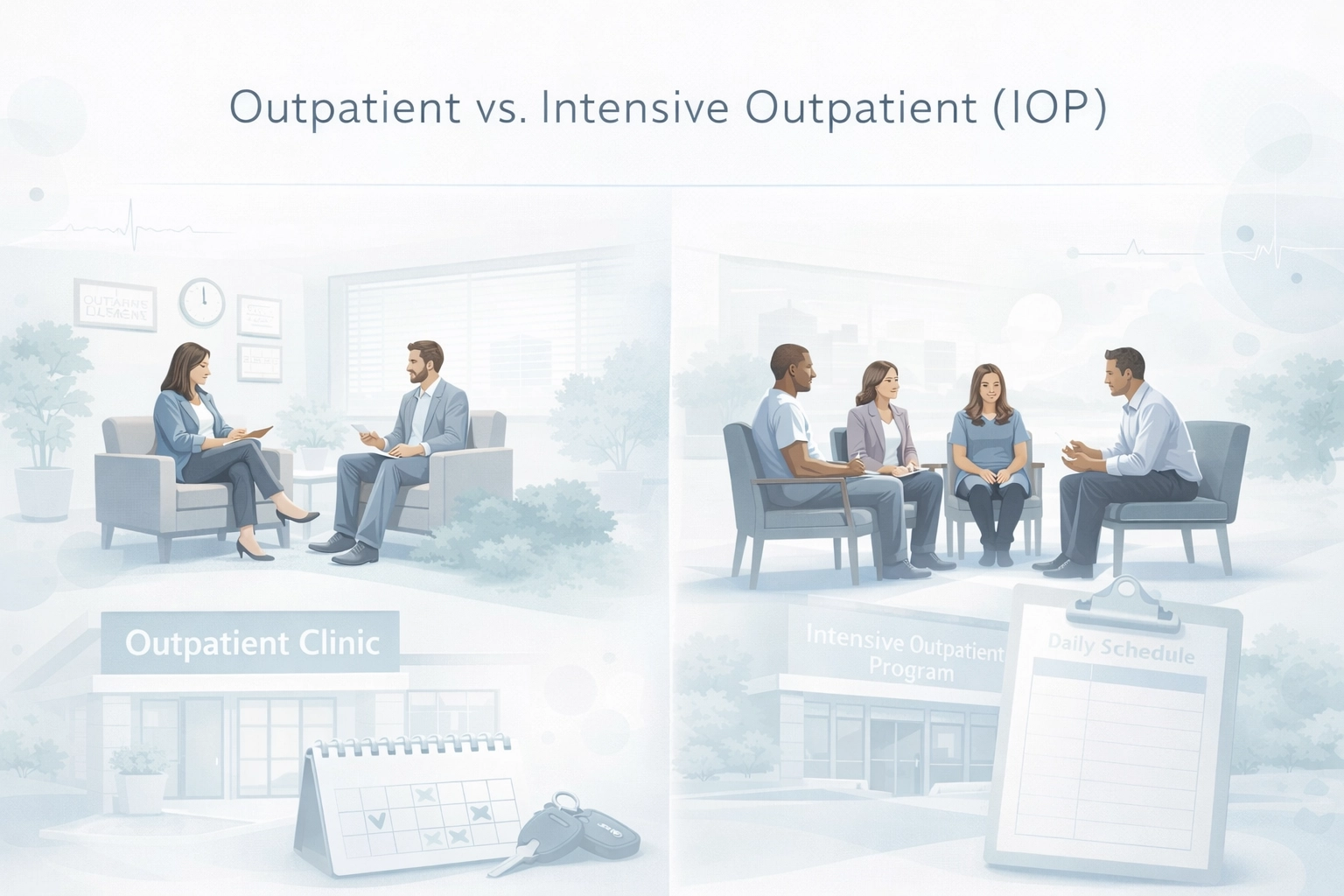
However, not all outpatient care is the same. The two primary levels you will encounter are Outpatient Treatment (OP) and Intensive Outpatient Treatment (IOP). Understanding which one fits your current landscape is a transformative step in your recovery journey.
What is Outpatient Treatment (OP)?
Standard Outpatient Treatment (OP) is often characterized by its flexibility and its focus on long-term maintenance. In this model, the time commitment is relatively low, usually consisting of one or two sessions per week. These sessions are typically one-on-one therapy focused on individual goals, relapse prevention, and navigating the stressors of daily life.
For many, OP is the final stage of a structured recovery process or a starting point for those with mild symptoms and a very stable home environment. It is the "maintenance" phase of emotional well-being. Because it involves fewer than 20 hours of treatment per week, and often as little as one or two hours, it is the least disruptive to your work or parenting schedule.

What is Intensive Outpatient Treatment (IOP)?
An intensive outpatient program in Maple Valley is a more robust, structured approach to recovery. It is designed for those who need more than a weekly check-in but don’t require the 24/7 supervision of a residential "rehab."
IOP typically requires a commitment of 9 to 20 hours per week, often spread across three to five days. These sessions usually last several hours at a time and involve a multifaceted approach, including:
- Group therapy sessions
- Individual counseling
- Educational workshops on addiction and the brain
- Family therapy components
- Relapse prevention planning
IOP provides a higher level of accountability. It’s a "deep dive" into the underlying issues of substance use, such as trauma, anxiety, or depression, while providing you with a community of peers who are walking a similar path.
Key Differences: Breaking Down the Numbers
To help you visualize which level of care might be right for you, it helps to look at the practical differences in how these programs operate.
| Feature | Intensive Outpatient (IOP) | Standard Outpatient (OP) |
|---|---|---|
| Hours per Week | 9–20+ hours | 1–5 hours |
| Frequency | 3–5 days per week | 1–2 days per week |
| Primary Focus | Stabilizing symptoms and building a foundation | Long-term maintenance and life skills |
| Duration | Typically 30–90 days | Ongoing / Flexible |
| Structure | High (Group and Individual) | Low (Primarily Individual) |
Intensity and Frequency
The primary difference is how much of your week is dedicated to your recovery. IOP is an "intensive" commitment because it seeks to create a significant shift in behavior and mindset in a relatively short period. If you feel like your substance use is escalating or if you’ve tried to cut back on your own without success, the structure of an IOP provides the "scaffolding" you need to stay upright during the early, fragile days of sobriety.
Treatment Approach
In an outpatient drug rehab in Maple Valley, standard OP therapy is often a singular conversation between you and a counselor. In contrast, IOP is a comprehensive program. It addresses the whole person. You might spend two hours in a group setting learning about how stress triggers cravings, followed by an hour of individual therapy to process personal trauma. This multifaceted approach is why IOP is often more effective for those dealing with co-occurring mental health issues like anxiety or depression. You can learn more about our specific approaches to mental health care to see how these methods integrate.

Who Should Choose IOP?
Deciding to enroll in an IOP is a significant life transition. It requires carving out substantial time in your calendar, which can feel daunting when you’re already juggling a career and family. However, IOP is often the best fit for individuals who:
- Are experiencing acute symptoms that interfere with work or relationships.
- Have a stable home environment but need more than once-a-week support to stay sober.
- Are transitioning out of a residential treatment program (often called "stepping down").
- Need the accountability of a group setting to feel less isolated in their struggle.
If you find that your internal monologue is constantly dominated by thoughts of substance use, or if the "functional" mask you’ve been wearing is starting to slip, an IOP offers the intensive support needed to regain control without leaving your life behind.
Who Should Choose Standard Outpatient?
Standard Outpatient (OP) is a gentle, steady resource. It is ideal for those who:
- Have completed an IOP and are ready for more independence.
- Have a strong, long-term support system and low risk of immediate relapse.
- Are dealing with very early-stage substance use issues that haven't yet caused major life disruptions.
- Need a professional "check-in" to maintain their mental health guide and emotional well-being.
The Benefits of Staying Local in Maple Valley
Seeking an outpatient drug rehab in Maple Valley means you don't have to choose between your health and your community. When you receive treatment locally at Thrive Behavioral Health, you are building a recovery network in the same environment where you live your daily life.
There is a unique advantage to walking out of a therapy session and immediately applying what you've learned to a real-life situation, whether that’s a stressful interaction at work or a busy evening managing your children's schedules. It turns the "theory" of recovery into a practical, lived experience.

Addressing the Complexity of the Transition
We know that the transition into any level of care is a manageable shift, but it doesn't always feel manageable at first. You might worry about what your employer will think or how you will explain your absence to your family.
The truth is that most people find that being proactive about their health actually makes them better employees and more present parents. By committing to a program like an intensive outpatient program in Maple Valley, you are investing in your future self. You are moving from a state of "surviving" the day to a state of "thriving" in your life.
If you are feeling a mix of uncertainty and hope, that is completely normal. Our team at Thrive Behavioral Health is here to act as your expert resource, helping you navigate the patient resources and clinical assessments necessary to determine the right level of care for your specific situation.
Taking the Next Step
Whether you need the robust structure of an IOP or the steady support of standard outpatient therapy, the goal is the same: to help you find your way back to the person you want to be. You don't have to figure this out alone.
If you're ready to explore which level of care fits your life, we invite you to look through our services or reach out to us directly. We can help you understand what to expect from an assessment and how we can tailor a plan to your unique needs.
Recovery is not a one-size-fits-all solution. It is a personal, evolving journey. Whether you are seeking help for yourself or a loved one, understanding these levels of care is the first step toward a healthier, more balanced life.
To start the conversation and find the support that fits your schedule and your goals, please contact us today. Together, we can find the path that leads you to the life you deserve.